
Capitalism at the Crossroads
There are two types of Capitalism – Corporate Capitalism and Peoples’ Capitalism.
The Oxford Dictionary defines Capitalism as an economic and political system in which a country’s trade and industry are controlled by private owners for profit.
The key word in this definition is private and for profit. Corporate Capitalism focuses entirely on profits while Peoples’ Capitalism puts equal weights to the word private ownership by people and profits. This is a major difference between the two types.
Corporate Capitalism has led to huge wealth gaps between the top 1% of the populations and the remaining 99%. In Canada, the top 1% of families hold nearly a quarter of the nation’s wealth. This in turn has created social troubles and the breakdown of trust in our society especially around our institutions and capitalism itself. More of the Gen Z generation are self describing themselves as Socialist/Communist than any other previous generation.
Socialism/Communism is definitely not the answer to wealth disparity. History proves that a socialist/communist system of economic distribution only creates a country of scarcity and poverty. The top 1% will thrive in any economic system while it’s the middle and lower class that become destitute.
The answer to corporate capitalism is peoples capitalism where ordinary working people have a chance to privately own the means of production and to increase their wealth so that the country can sustain a strong middle class and upward mobility for the people not yet in the middle class. A strong middle class also means a strong democracy.
Another very important aspect of peoples capitalism is in response to demographic changes in the aging population of owners’ of privately held businesses. Studies show that in SME’s (small and medium sized enterprises) only 25% will actually be sold while 75% will close up shop leaving employees and suppliers out in the cold. This is tremendously inefficient and a poor use of manpower, and has a negative impact on the economy.
Enter Employee Ownership (ESOPs)
Over 40 years ago the United States Government instituted a peoples capitalism through a plan called ESOPs (Employee Stock Ownership Plans). An ESOP addresses all the fault lines in the Corporate capitalism model. By focusing not only on profits but also people it created wealth for many families, exit plans for retiring owners and more highly successful companies. Studies over the last 40 years in the USA and in Britain, where there is also a legislated structure for employee ownership, have confirmed these statements of higher growth, larger profitability, and companies that are more productive. In addition it created excellent sustainability of growing companies.
Canada has been late to the game but it too has been involved in creating Employee Share Ownership Plans (ESOPs) using current tax and security laws to design and implement them. We have used the ESOP term in Canada to refer to any employee share ownership structure (such as: share purchase, stock option, and phantom or EVOP™️). Recently the Canadian government legislated what’s called an EOT or Employee Ownership Trust that, in certain circumstances, can be a very successful model for owners who are retiring and need to sell their company.
ESOPs in Canada: EOTs, Share Purchase, Stock Options and Phantom Plans
Currently therefore, a business owner of an SME in Canada has several options (such as: EOT, share purchase, stock option, and phantom or EVOP™️) in choosing a design structure that will meet their needs in implementing an ESOP in their company. The typical goals of these owners is to grow the company through attraction and retention of highly motivated and successful employees and / or as a means of exiting the company. Many of our clients use the ESOP as a bridge to selling the company in a time frame of 3 to 10 years. The EOT on the other hand is a much shorter time frame and is appealing to owners who want to sell in a time frame of a year or less.
The owners can choose between a legislated ESOP structure (an EOT) or a non legislated ESOP (such as a share purchase plan). The non legislated ESOP can include a share equity structure where employees purchase shares in the company, and / or a stock option program and / or a phantom plan which works like a super bonus program. We call a phantom plan an EVOP™️ (Equity Value Ownership Plan).
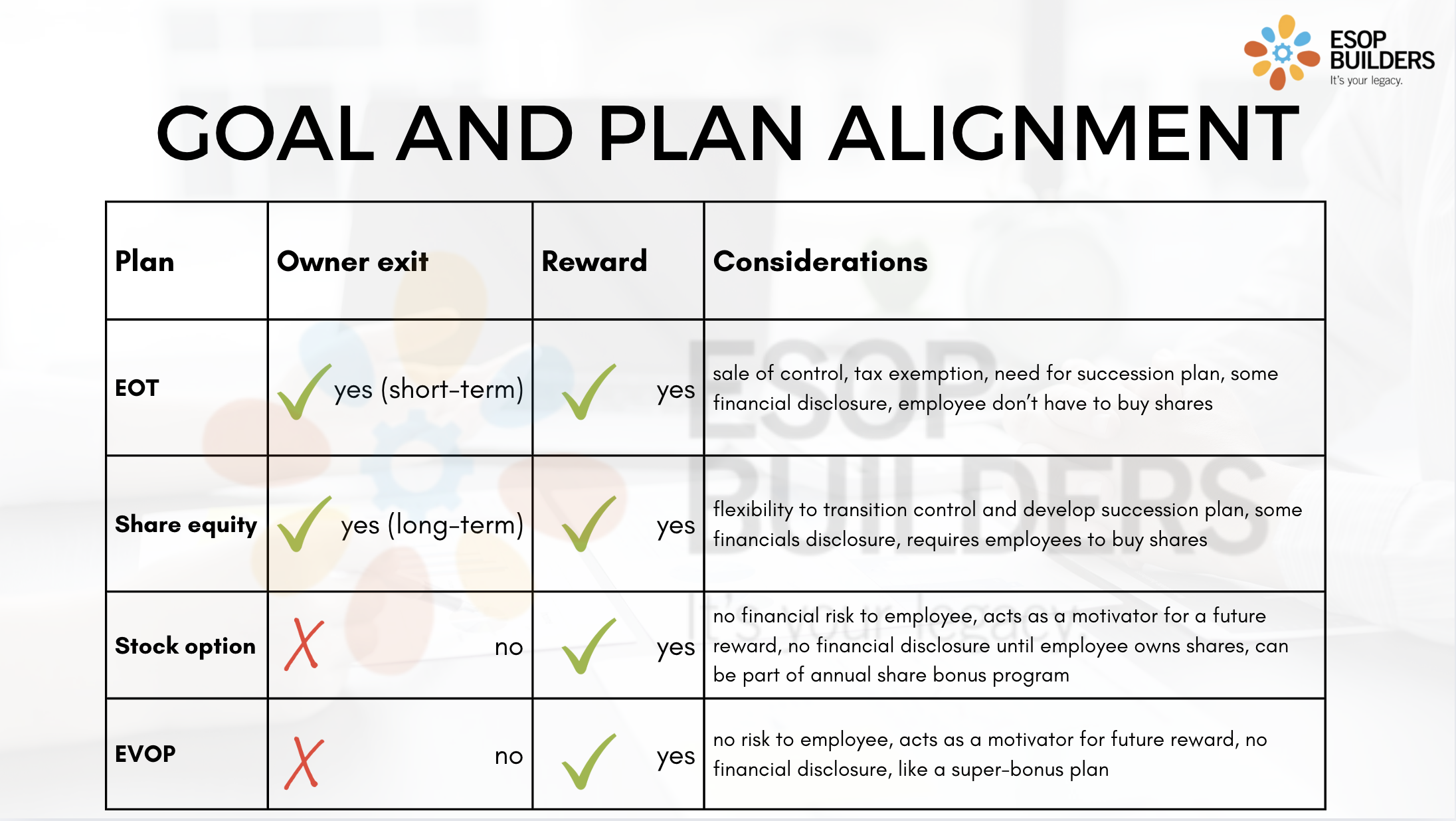
There are pros and cons to each plan and there are tax advantages to each plan as well that would need to be reviewed to implement an optimal plan that achieves the owners goals and the best tax position for the owner, the company and the employees.
Successful ESOPs don’t only focus on the technical components
Studies in the USA have shown that there is one critical element that is common to successful ESOP design that is often overlooked. That is the concept of participation and engagement. In creating a culture of ownership its important to lay the foundations of the ESOP right away through a process of employee participation. We have seen many examples of companies that plow forward with their designs without understanding the impact of good (or bad) communication and the power of highly engaged employees participating in structuring the program. To address this need our process is based on a two-stage approach.
Stage one is to conduct a feasibility review of the company to ensure what type of model will work in the corporate culture and business structure. This is done by reviewing the corporate structure, clearly understanding the goals of the owner, and by interviewing identified team members in the company. One of the key factors being checked is interest from the team; what’s the point of doing an ESOP if no one is interested? At the end of stage one, the owner has a more detailed foundation about next steps to take and can clearly see if there are any barriers that must first be mitigated.
Stage two then designs the program based on data collected in stage one and sets up a clear communication strategy so each employee who is to be part of the program has all their questions answered and can understand the program well. Components that are part of stage 2 include the strategic design, communication and implementation of the plan, business valuation, legal documentation, and tax review and structuring (to the extent required).
Conclusion on ESOPs in Canada and Employee Ownership
Capitalism is the way to make a country and its owners wealthy. However, only Peoples’ Capitalism will deliver a sustainable wealthy economy where the fruits of hard work are shared with employees. A balance sheet shows financial numbers but it does not show the greatest asset a company has, and that is its people. By involving employees in ownership we create not only wealth but a culture of workers thinking and acting like owners. A person who owns their own house takes care of it usually better than someone who rents. It’s just human nature. The future of Capitalism must be people capitalism which means employee ownership.
Over the last 25 years ESOP Builders Inc. has been involved in implementing and designing more than 160 ESOPs for privately held Canadian companies in the SME space. Find out more.

National Flag of Canada. Paul Giamou / Aurora / Getty Images
Written by Perry Phillips, President, ESOP Builders Inc.